Open interest (OI)
Positioning against the last 24 hours
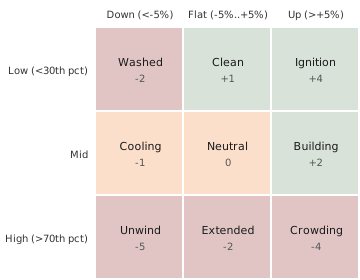
Where open interest sits in its own history — low, mid, high — crossed with how much it moved in the last 24 hours — down, flat, up. Each combination gets a name and a score from +4 to -5.
Takeaway: The same OI level means something different depending on whether it’s rising, falling, or holding — the grid is what tells them apart.
What
OI compares two things: the percentile of current open interest against its own recent history, and the percent change over the last 24 hours. Crossing those gives nine named states — Ignition, Building, Clean, Neutral, Cooling, Extended, Washed, Crowding, Unwind — each carrying a score from +4 (Ignition) down to -5 (Unwind). It refreshes roughly hourly.
So what
Low OI with a fresh 24-hour increase (Ignition) reads very differently from high OI with a fresh 24-hour increase (Crowding) — the first is new positioning coming into a relatively empty book, the second is more positioning piling onto a book that’s already full. Same direction of change, opposite meaning, because the starting level is different.
Now what
Ignition and Building are where “fresh interest, room to run” ideas come from. Crowding and Unwind are where “this move is more full than it looks” caution comes from — a lot of positioning has already piled in, or is actively leaving. Neutral, Cooling, and Extended sit in between and usually defer to whatever the other columns are saying.